

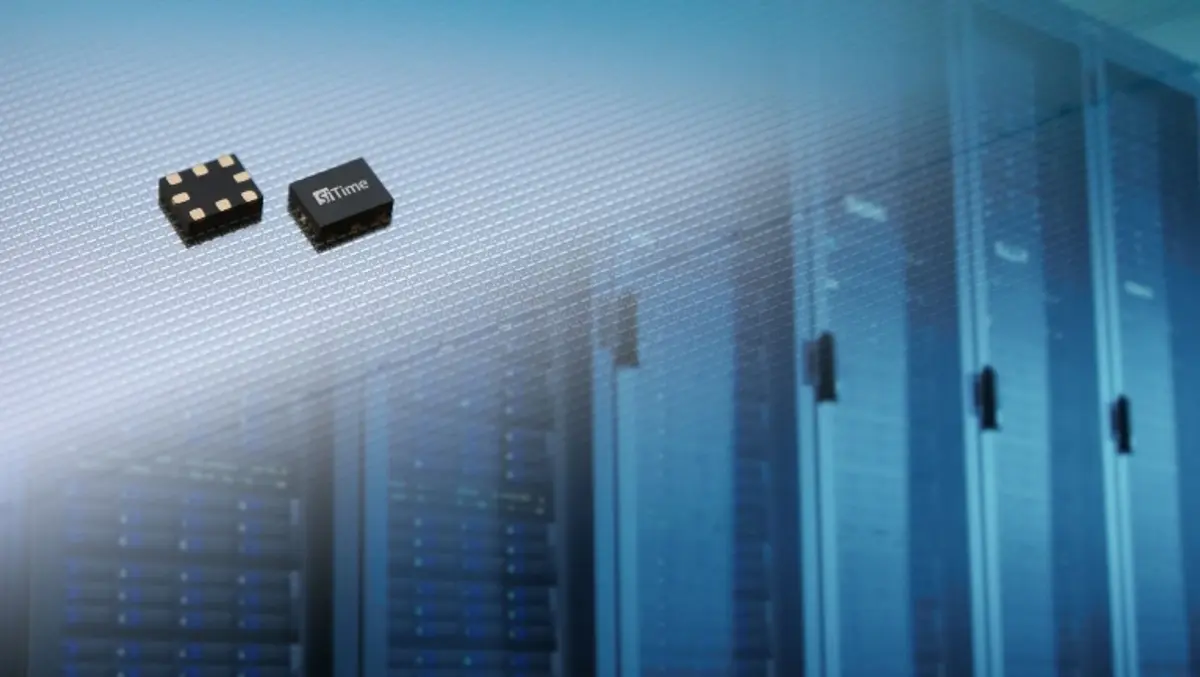
SiTime targets AI data centres with Elite 2 timing chip
Tue, 5th May 2026.webp)
SiTime has introduced its Elite 2 Super-TCXO for AI data centres, positioning the oscillator to improve time synchronisation across GPU clusters.
The launch targets what it describes as a cumulative USD $1.5 billion market by 2030, as operators seek tighter synchronisation in systems built around large numbers of graphics processors.
Time synchronisation has become a more prominent issue in AI infrastructure because training and inference workloads are distributed across many GPUs that must exchange data within tightly controlled windows. Small clocking errors can force processors to wait for one another, reducing effective utilisation and, in some cases, causing faults that interrupt workloads.
According to SiTime, industry requirements are shifting from about 1 microsecond synchronisation across an AI cluster to 10 nanoseconds. The Elite 2 Super-TCXO is intended to deliver sub-nanosecond synchronisation and reduce timing errors between GPUs.
The device falls into the temperature-compensated crystal oscillator category, although SiTime uses a MEMS-based design rather than quartz. It offers 1 nanosecond synchronisation accuracy, a frequency temperature slope of ±2 ppb/°C dF/dT, Allan Deviation of 6 × 10⁻¹², and frequency stability of ±50 ppb across a temperature range of -40 to 105°C.
It will be available in 3.2 mm × 2.5 mm plastic and 5.0 mm × 3.2 mm ceramic packages. SiTime listed the part numbers as SiT5234, SiT5235, SiT5434 and SiT5435, and said the product is sampling now.
The oscillator also includes digital frequency tuning intended to simplify network design in timing-sensitive systems. SiTime says the device avoids activity dips and micro jumps associated with quartz technology and is resistant to shock, vibration and board bending.
Piyush Sevalia, Chief Business Officer at SiTime, described the issue as an efficiency constraint in AI systems.
"Industry reports show GPU utilization in AI clusters can be as low as 20 to 40 percent-a large and largely hidden tax on AI infrastructure," Sevalia said.
He said the technical demands of AI clusters make timing precision a system-level concern rather than a narrow component issue.
"AI workloads are distributed across GPUs in tightly orchestrated time slots. Even small timing errors force wait cycles to avoid data corruption, and in extreme cases can trigger GPU timeouts and system restarts. Poor synchronization directly caps GPU utilization," he said.
SiTime said it worked with AI system architects at hyperscalers and silicon providers while developing the product. Based on that work, the company concluded that oscillator performance can directly affect cluster-wide synchronisation and overall utilisation.
"To address this, the industry is driving towards a target of 10 nanoseconds time synchronization across an AI cluster, down from 1 microsecond today. We collaborated closely with leading AI system architects at hyperscalers and silicon providers and concluded that the right oscillator can significantly improve cluster-wide synchronization. That's why we developed the Elite 2 Super-TCXO. The device delivers sub-nanosecond synchronization, 10X better than target, which is enabled by its exceptional thermal and short-term stability. With these characteristics, Elite 2 minimizes time errors between GPUs, unlocking higher system utilization, greater throughput and better performance per watt. This is the result of SiTime leadership and systems thinking, applied to one of AI's hardest problems," he said.
Market context
The announcement reflects a broader trend in AI infrastructure, where bottlenecks are shifting beyond raw processor performance to the co-ordination of distributed systems. As clusters grow larger and refresh cycles shorten, suppliers are positioning components such as networking silicon, interconnects, memory and timing devices as contributors to overall system efficiency.
Sameh Boujelbene, Vice President at Dell'Oro Group, said the economics of AI systems are increasing the pressure to keep GPU resources fully engaged.
"AI networks must operate with extremely high efficiency to fully utilize expensive GPU resources," Boujelbene said.
She said the pace of change in back-end AI systems is raising the importance of synchronisation accuracy.
"As AI back-end infrastructure refreshes at a much faster cadence than traditional non-accelerated infrastructure, time synchronization accuracy becomes increasingly important to sustaining performance across rapidly evolving data center architectures," she said.
SiTime expects the Elite 2 Super-TCXO to enter commercial production in the third quarter of 2026.