

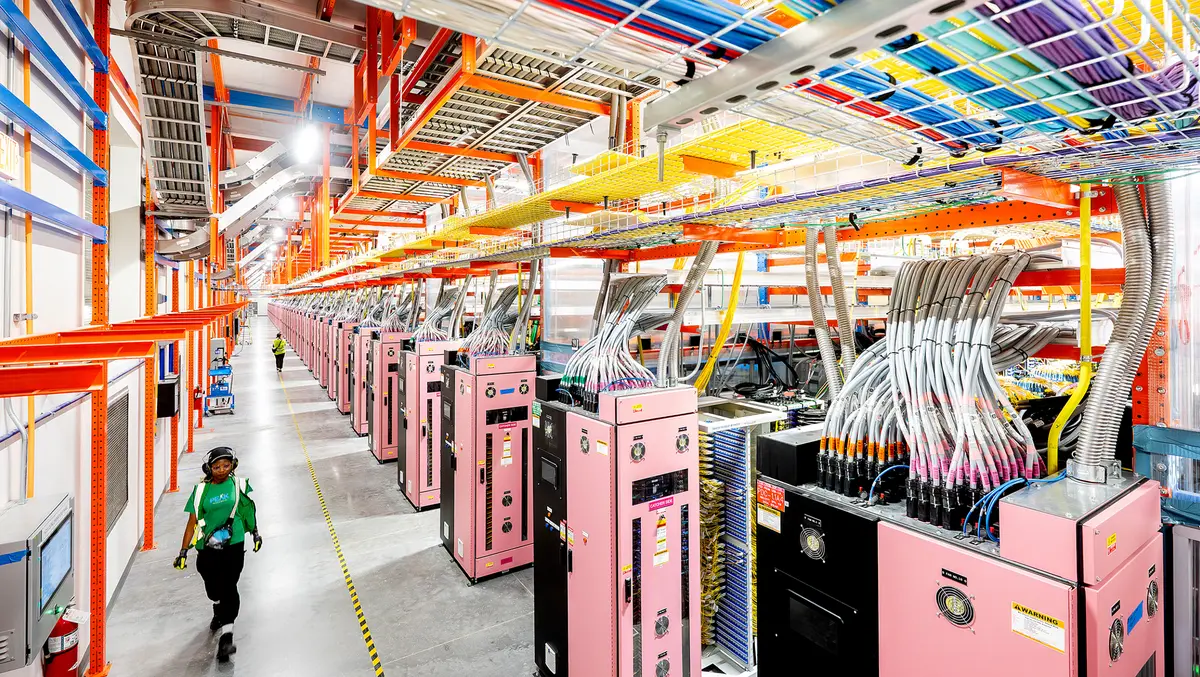
AWS's $11bn Indiana data centre powers Anthropic's AI growth
Sun, 2nd Nov 2025
In rural Indiana, a once quiet stretch of farmland has been transformed into one of the largest artificial intelligence infrastructure projects ever undertaken. Amazon Web Services' (AWS) $11 billion Project Rainier data centre campus near New Carlisle became fully operational in October 2025, marking what AWS has described as "one of the most ambitious projects" in its history.
From farmland to compute power
Construction on Project Rainier began in September 2024, and within just seven months, seven of its 30 planned buildings were up and running. The site spans 1,200 acres and will ultimately draw 2.2 gigawatts of power - enough to serve about 1.6 million homes. Each of the vast buildings exceeds 200,000 square feet and forms part of what AWS says is "the world's largest cluster of non-Nvidia AI chips."
Indiana Michigan Power, a subsidiary of American Electric Power, partnered with AWS to deliver the necessary high-voltage infrastructure. The New Carlisle location was chosen for its access to transmission lines and supportive local government policies.
Partnership built on AI ambition
Project Rainier's purpose extends beyond data storage: it was designed to serve Anthropic, the San Francisco-based AI firm founded by former OpenAI researchers Dario and Daniela Amodei. The partnership between the two companies has become a cornerstone of AWS's strategy to support generative AI at scale.
Amazon first invested $1.25 billion in Anthropic in September 2023, followed by a further $2.75 billion in early 2024 and $1.3 billion later that year. By late 2024, Amazon committed an additional $4 billion, making AWS Anthropic's "primary training partner and cloud provider." In total, Amazon's stake reached $8 billion - surpassing Google's $3 billion investment in Anthropic.
Custom silicon drives innovation
At the heart of Project Rainier lies AWS's custom silicon technology. The facility currently runs around 500,000 Trainium2 chips, designed specifically for large-scale AI model training. AWS plans to double that number by the end of 2025.
Ron Diamant, AWS vice president and distinguished engineer for Trainium, said the project was "one of the most ambitious projects AWS has undertaken to date," adding that it would "usher in the next generation of artificial intelligence models."
Trainium2's architecture provides 30 to 40 per cent better price-performance than comparable GPU-based systems. The chips are arranged in high-density configurations called UltraServers - each with 16 interconnected Trainium2 chips - and in larger UltraClusters linking 64 chips across multiple servers.
Anthropic engineers collaborated directly with AWS's Annapurna Labs to optimise the hardware. The company stated its team was "writing low-level kernels that allow us to directly interface with the Trainium silicon, and contributing to the AWS Neuron software stack." This collaboration enabled Claude model training to operate more efficiently across AWS infrastructure.
Beyond one location
Despite its physical base in Indiana, Project Rainier functions as part of a multi-location supercomputer. AWS has connected several US data centres through ultra-high-speed networks, addressing energy and cooling challenges common in single-site AI clusters. The distributed setup delivers more than five times the compute power used to train earlier Claude models, enabling Anthropic to accelerate model development.
Matt Garman, AWS's chief executive, said Project Rainier was "running and training their models today," positioning the site as an active engine for Anthropic's frontier model work rather than a speculative future project.
Local impact
Project Rainier has also reshaped the Indiana economy. The $11 billion investment represents the largest capital commitment in the state's history, creating more than 1,000 jobs with wages above the county average. AWS contributed $7 million to highway improvements, $114 million to utility upgrades, and established a $100 million community fund to support education and workforce development.
State incentives included a 50-year sales tax exemption on capital investment and an 85 per cent exemption on personal property tax for the data centre, yet AWS is still projected to pay over $722 million in taxes over 35 years.
Anthropic's growth story
Founded in 2021, Anthropic has quickly become one of the most significant names in AI research. Its Claude models, designed around principles of safety and interpretability, have evolved rapidly - from Claude 1 in March 2023 to Claude 4 in May 2025. By the end of 2025, the company reported annual revenues of around $7 billion.
Through AWS's Bedrock service, Claude models are accessible to enterprise clients such as Pfizer, Intuit, Perplexity, and the European Parliament. The AWS partnership has therefore given Anthropic both the scale and commercial reach to compete with OpenAI.
A multi-cloud future
Even as Anthropic deepens its AWS collaboration, it maintains a multi-cloud strategy. In October 2025, the company announced a major expansion with Google Cloud, gaining access to up to one million Tensor Processing Units (TPUs) - the largest such commitment in Google's history. Despite this, Anthropic reaffirmed AWS as its primary training partner, using multiple providers to balance cost, performance, and flexibility.
The next chapter
AWS is already preparing Trainium3, its next-generation AI chip, promising four times the performance and 40 per cent better energy efficiency. Anthropic continues to contribute technical insights to optimise the design.